Kaspa vs Solana: Fast Proof-of-Work vs Fast Proof-of-Stake
Solana and Kaspa are both built for speed, with very different trade-offs. Compare consensus, real throughput, finality, outages and ecosystems in 2026.

Bruma
Author
In short
Solana and Kaspa are both fast, but they take opposite approaches. Solana is a proof-of-stake network with powerful validators, no maximum supply and a large ecosystem for trading, payments and apps. Kaspa is a proof-of-work BlockDAG producing 10 blocks per second, with a supply capped at about 28.7 billion KAS and applications that are only starting.
Two fast networks, two opposite bets
Ask what the fastest blockchains are and Solana will be on almost every list. Ask which proof-of-work network is fastest and the answer is Kaspa. Both promise transactions that feel instant, yet they get there in almost opposite ways.
Solana bets on powerful validators, a precise shared clock and proof-of-stake. Kaspa bets on proof-of-work miners and a BlockDAG that keeps blocks created in parallel. In this comparison we will look at how each design works, what their real numbers are in October 2026, where each has struggled, and which kinds of use they suit best.
How Solana reaches its speed
Solana launched its mainnet beta in March 2020. It is a proof-of-stake network: validators stake SOL and take turns producing blocks according to a published schedule. A few design choices make it fast:
- Proof of History, a cryptographic clock. It is not a consensus mechanism by itself, but it gives every validator the same sense of time, so the network can plan in advance who produces each short slot.
- Tower BFT, the voting system validators use to agree on the chain. Validators vote on blocks continuously, which is why a large share of Solana's transactions are actually vote messages.
- Parallel execution with Sealevel. Transactions declare which accounts they touch, so the ones that do not overlap can run at the same time on many CPU cores.
- Demanding hardware. Validators run powerful servers with fast networking, which raises throughput but also raises the cost of running one.
A new consensus design called Alpenglow, approved by Solana's validators in 2025, aims to bring finality down to around 150 milliseconds. It was running on Solana's test networks in September 2026 but had not been activated on mainnet as of early October 2026.
How Kaspa reaches its speed
Kaspa launched in November 2021 as a proof-of-work network. Miners compete with ASIC machines running the kHeavyHash algorithm, just as Bitcoin miners do with SHA-256. The difference is the ledger's shape.
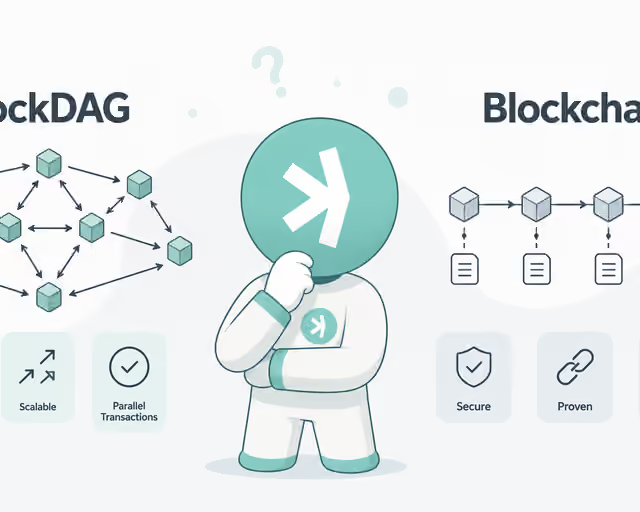
On a normal blockchain, two blocks found at the same time cannot both survive, so block times have to be long. Kaspa's BlockDAG lets a block reference several earlier blocks, so parallel blocks are all kept. The GHOSTDAG protocol then puts every block in one agreed order. Since the Crescendo upgrade of May 2025, this lets Kaspa produce 10 blocks per second. Our article What is Kaspa? explains the mechanism step by step.
Throughput: claims against real numbers
Raw transactions-per-second figures are the most abused numbers in crypto, so it is worth being careful.
Solana's often-quoted 65,000 TPS is a theoretical capacity. In practice, in 2026 the network typically processes around one to two thousand user transactions per second on average, with higher peaks. That is still very high for a public blockchain, and it comes from real, sustained demand: trading, payments, stablecoins and a lot of automated activity.
Kaspa's capacity after Crescendo has been reported in the low thousands of transactions per second, with peaks around 5,500. The Kaspa team expected the move from one to ten blocks per second to improve throughput by eight to nine times. Actual usage, though, is far lower than capacity: Kaspa simply does not have Solana's volume of activity yet.
The honest summary is that both networks have plenty of headroom for their current demand, and Solana is the one that has proven it under heavy, real-world load.
Speed, finality and fees
On Solana, a slot lasted 400 milliseconds from launch until August 2026. It was then cut in four steps and reached 200 milliseconds on October 9, 2026. Transactions are usually confirmed by a supermajority of validators within a second or two, and they become fully finalized after 32 slots: roughly 6 to 7 seconds at 200 milliseconds, compared with about 13 seconds at the original slot time. Fees are tiny: the base fee is a fraction of a cent, and users can add a priority fee when the network is busy.
On Kaspa, a block arrives every 100 milliseconds. A transaction usually appears within a second and is described by the project as fully confirmed in about ten seconds on average. Finality is probabilistic, as on Bitcoin: each additional block makes a reversal more expensive. Fees are also very low under normal conditions.
For everyday payments, both feel instant. Kaspa still produces blocks more often, but Solana now reaches full finality a little sooner. The bigger difference lies in what stands behind that speed: staked capital and a validator vote on Solana, accumulated proof-of-work on Kaspa.
Reliability and decentralization
Solana's history includes a real weak point. Between 2020 and February 2024 the network suffered seven full halts, mostly caused by floods of transactions or software bugs, and it needed coordinated restarts by validators. Since February 2024 it has run without a full outage. A second, independently written validator client, Firedancer, went fully live on mainnet in December 2025. It still runs on a minority of stake, but it reduces the chance that a single bug stops the whole network.
Solana's decentralization debate centers on its validators: there were fewer than 800 of them in 2026, down from about 2,500 in early 2023. They run expensive hardware, and stake is concentrated among the largest. Kaspa has its own version of the problem. Its mining is dominated by ASICs, and most hashrate flows through a handful of large pools. Kaspa has no reported network-wide halt on record, but it also has a smaller security budget and much less traffic to cope with.
Neither network is decentralized in the idealized sense. They concentrate power in different places, and those places are worth knowing before you rely on either.
Ecosystem and programmability
Solana has one of the largest and most active ecosystems in crypto: decentralized exchanges, lending, stablecoin payments, NFTs, memecoins and consumer apps. Developers write programs mostly in Rust, with mature tools such as the Anchor framework, and there are many wallets and integrations to choose from.
Kaspa gained programmability only recently. The Toccata hard fork of June 2026 added covenants, rules that limit how coins can be spent in the future, and native verification of zero-knowledge proofs. The Igra network, live since March 2026, runs EVM-compatible smart contracts on top of Kaspa, and KRC-20 tokens have existed since 2024. It is a meaningful step, but the ecosystem is still small.
Supply and monetary policy
Solana has no maximum supply. New SOL is issued as staking rewards on an inflation schedule that started at 8% per year and declines every year toward a long-term rate of 1.5%, while half of every base fee is burned.
Kaspa has a fixed cap of about 28.7 billion KAS, issued only to miners. Its reward falls about 5.6% every month, halving every year, and around 96.7% of the supply had been mined by October 2026. You can explore the curve on our tokenomics page.
The key differences at a glance
| Feature | Solana | Kaspa |
|---|---|---|
| Launch | March 2020 (mainnet beta) | November 2021 |
| Consensus | Proof-of-stake, Tower BFT, Proof of History clock | Proof-of-work, GHOSTDAG BlockDAG |
| Block interval | 200 ms (400 ms until August 2026) | 100 ms |
| Finality | About 6 to 7 seconds (Alpenglow pending) | Probabilistic, about 10 seconds in practice |
| Real throughput (2026) | About 1,000 to 2,000 user TPS on average | Capacity in the low thousands of TPS, low usage |
| Outages | Seven full halts, none since February 2024 | No reported network-wide halts |
| Supply | No cap, declining inflation | About 28.7 billion KAS, capped |
| Ecosystem | Large and mature | Early stage |
So, which one should you use?
Back to the starting question: two fast networks, two opposite bets. Solana has shown that a high-performance proof-of-stake chain can carry a huge amount of real activity, and it seems to have left its difficult period of outages behind. Kaspa has shown that proof-of-work does not have to be slow, and it keeps the energy-based security model that many people trust most.
If you need a busy ecosystem for trading, payments or apps today, Solana is the practical choice. If you value proof-of-work security and a capped supply, and you are interested in a fast base layer that is just starting to support applications, Kaspa is worth following closely. Either way, they are volatile assets, and the right choice depends on what you actually want to do with them.
FAQs
Quick answers to the questions readers ask most about this topic.
That figure is a theoretical capacity, not real usage. In 2026 Solana typically processes one to two thousand user transactions per second on average, plus a large number of validator vote transactions. It is still one of the busiest networks in crypto.
Both feel fast to users. Solana produced a block every 400 milliseconds until August 2026, then cut its slot time in four steps to 200 milliseconds on October 9, 2026. Transactions are usually confirmed within a second or two, and full finality (32 slots) now takes roughly 6 to 7 seconds, down from about 13. Kaspa produces a block every 100 milliseconds and describes transactions as fully confirmed in about ten seconds on average.
Solana had seven full network halts between 2020 and February 2024. Since then it has run without a full outage for more than two and a half years, and a second independent validator client, Firedancer, has started to reduce the risk of a single software bug stopping the network.
Only in a more limited way so far. Kaspa added covenants and zero-knowledge proof verification with the Toccata upgrade in June 2026, and the Igra network runs EVM smart contracts on top of it. Solana has a large, mature ecosystem of DeFi, payments and consumer apps.
Solana has no maximum supply: new SOL is issued as staking rewards on a declining inflation schedule. Kaspa is capped at about 28.7 billion KAS, issued only through mining, and around 96.7% had been mined by October 2026.

Author
Bruma- Published
- Last updated