Kaspa vs Bitcoin: Same Proof-of-Work, Different Design
Kaspa and Bitcoin both rely on proof-of-work, but differ in speed, supply, security budget and adoption. A fair, side-by-side comparison for 2026.

Bruma
Author

In short
Kaspa and Bitcoin both use proof-of-work and launched without a premine, but Kaspa produces 10 blocks per second and confirms payments in about ten seconds, while Bitcoin makes one block every ten minutes. Bitcoin leads by far on security budget, liquidity and track record; Kaspa leads on base-layer speed and programmability.
If Kaspa is faster, why is Bitcoin worth so much more?
It is a fair question. Kaspa confirms a payment in seconds, while Bitcoin makes you wait minutes for the first confirmation. Yet in October 2026 Bitcoin's market capitalization is around $1.6 trillion and Kaspa's is around $1.2 billion, more than a thousand times smaller.
Speed is only one of the things a monetary network is judged on. In this comparison we will look at how the two networks are designed, how fast they really are, how their supplies work, what secures them and what you can build on each. By the end, the gap in value should make more sense, and so should the places where Kaspa genuinely does something Bitcoin cannot.
Two networks with the same foundation
Bitcoin and Kaspa share more than most comparisons admit. Both are proof-of-work networks: miners spend electricity to find blocks, and the chain with the most accumulated work defines the history. Both launched without a premine or a presale. Both are permissionless, so anyone can run a node or send a transaction.

The differences start with age and ambition. Bitcoin launched in January 2009, created by the pseudonymous Satoshi Nakamoto, who first described it in a short white paper in 2008. Since then it has spent more than fifteen years becoming the reference asset of the crypto world. Kaspa launched in November 2021, building on years of academic research by Yonatan Sompolinsky and others into how proof-of-work could scale. Its goal is to keep Bitcoin's security model while removing its speed limit.
Speed: ten minutes against a tenth of a second
Bitcoin produces a block about every ten minutes on average. Each block holds a limited amount of data, which puts its base-layer capacity at roughly seven transactions per second. Many exchanges and merchants wait for several confirmations, often six, before treating a payment as final, which means waiting about an hour.
Kaspa has produced 10 blocks per second since the Crescendo upgrade of May 2025. A transaction usually appears in a block within a second, and the Kaspa project describes it as fully confirmed in about ten seconds on average. Reported capacity is in the low thousands of transactions per second.
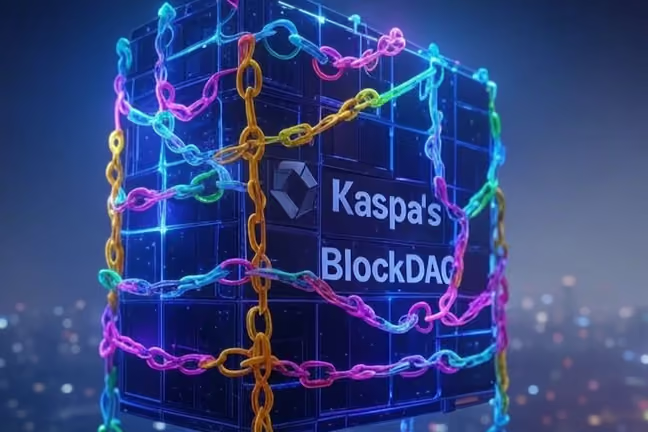
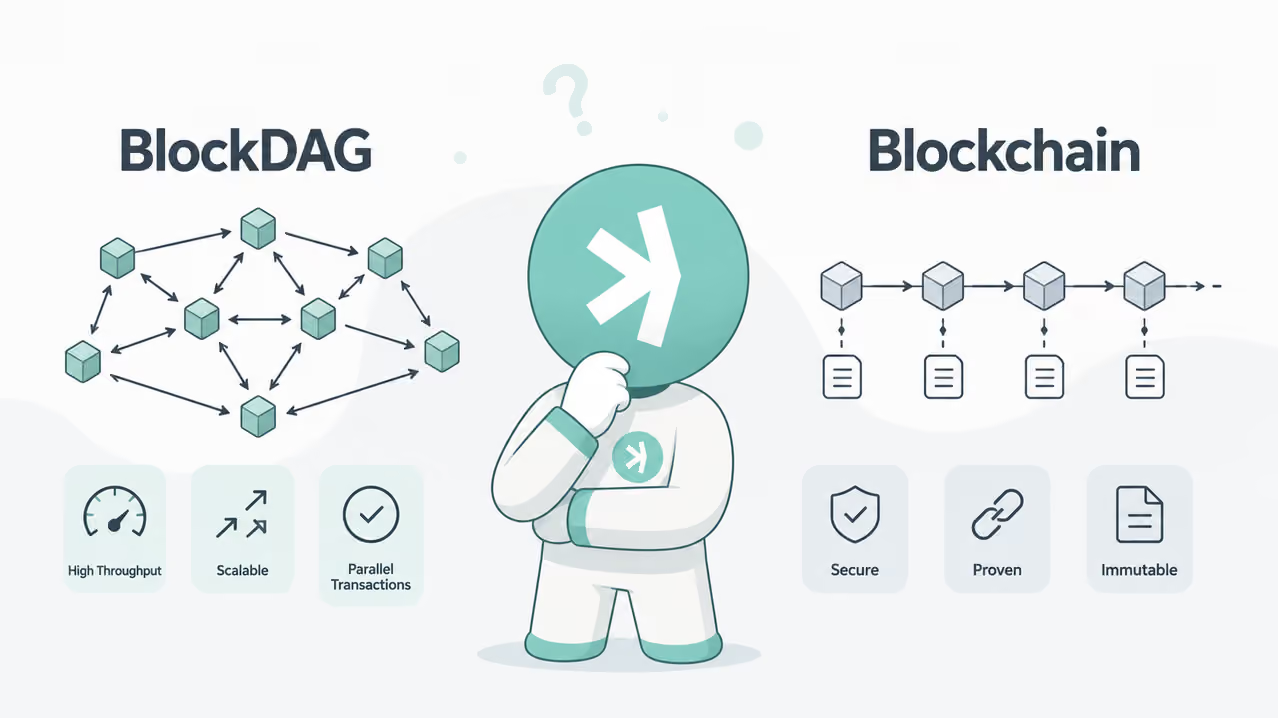
The reason Kaspa can do this is its BlockDAG: blocks created at the same time are kept and ordered instead of being discarded. Our article on BlockDAG vs blockchain explains the mechanism in detail.
Okay, but there is an important nuance. Bitcoin users who need speed do not usually wait for the base layer. The Lightning Network lets them open payment channels and send near-instant, very cheap payments that settle on Bitcoin later. Lightning has its own costs, such as managing channels and liquidity, but it means "Bitcoin is slow" is only true for on-chain transactions. Kaspa's advantage is that it is fast on the base layer itself, with no channels to open.
Supply and issuance
Both networks have a fixed maximum supply and issue new coins only through mining, but the schedules feel very different.
Bitcoin is capped at 21 million BTC. Every 210,000 blocks, roughly every four years, the block reward halves. The last halving, in April 2024, cut it to 3.125 BTC, and the next one is expected around 2028. More than 95% of all bitcoin has already been mined.
Kaspa is capped at about 28.7 billion KAS. Since 2022 its reward has fallen a little every month, by about 5.6%, which halves it every twelve months. In October 2026 the reward is about 2.06 KAS per block, and roughly 96.7% of the supply has been mined. The large unit count is just a design choice: it says nothing about value, the same way a pizza is not bigger because it is cut into more slices.
The practical difference is smoothness. Bitcoin's issuance drops in sudden steps that miners and markets anticipate for years, while Kaspa's drops gradually. You can compare the curves on our tokenomics page.
Mining and energy
Bitcoin uses the SHA-256 algorithm and Kaspa uses kHeavyHash. Both have been dominated by specialized ASIC machines for years, Bitcoin since 2013 and Kaspa since 2023, so neither can realistically be mined with a home computer anymore.
Energy use is often framed as a strength for Kaspa, and that framing deserves care. In proof-of-work, miners spend energy roughly in proportion to the value of the rewards they compete for, not in proportion to the block rate. Kaspa uses far less energy than Bitcoin mostly because its rewards are worth far less, not because its algorithm is magically efficient. If Kaspa's value grew to Bitcoin's size, its energy use would grow with it.
Security and decentralization
This is where Bitcoin's lead is hardest to overstate. Its hashrate, and the money spent every day to produce it, is enormous. To rewrite Bitcoin's recent history, an attacker would need to outspend the entire mining industry, which makes it the most expensive proof-of-work network to attack by a wide margin.
Kaspa uses the same kind of security, at a much smaller scale. Its network hashrate is around 340 PH/s in October 2026, and the value of the rewards paying for it is a tiny fraction of Bitcoin's. That is still a serious barrier, but it is a lower one.
Both networks have the same weak point in mining: hashrate concentrates in a handful of large pools. Kaspa's fast blocks help small miners in one specific way, because they earn rewards more steadily and do not lose blocks to orphaning. That is a real improvement, but it does not make Kaspa immune to pool concentration.
What you can build
Bitcoin keeps its base layer deliberately simple. Its scripting language is limited by design, and more complex use cases live on other layers: Lightning for payments, and a range of sidechains and newer protocols for tokens and contracts. That conservatism is part of why many people trust it as a store of value.
Kaspa has moved faster. The Toccata hard fork of June 2026 added covenants, which let coins carry rules about how they can be spent in the future, and native verification of zero-knowledge proofs. The Igra network, live since March 2026, runs EVM smart contracts on top of Kaspa, and KRC-20 tokens have existed since 2024. All of this is young, though, and the ecosystem is a small fraction of what exists around Bitcoin or Ethereum.
The key numbers at a glance

| Feature | Bitcoin | Kaspa |
|---|---|---|
| Launch | January 2009 | November 2021 |
| Consensus | Proof-of-work, heaviest chain | Proof-of-work, GHOSTDAG BlockDAG |
| Mining algorithm | SHA-256 | kHeavyHash |
| Block rate | About 1 block every 10 minutes | 10 blocks per second |
| Typical confirmation | Minutes to about an hour | About 10 seconds |
| Maximum supply | 21 million BTC | About 28.7 billion KAS |
| Issuance cuts | Halving every 4 years | Monthly cuts, halving every year |
| Fast payments | Lightning Network (layer 2) | Base layer |
| Programmability | Limited script, layers on top | Covenants, ZK verification, Igra EVM layer |
| Market cap (October 2026) | About $1.6 trillion | About $1.2 billion |
Live prices, market caps and their correlation are on our comparison dashboard.
Where each one leads
Bitcoin leads on almost everything that takes time to build: security budget, liquidity, exchange support, institutional products, brand recognition and a long track record without a successful attack on its consensus. For a store of value, those things matter more than speed.
Kaspa leads on base-layer performance. It shows that proof-of-work can confirm transactions in seconds without discarding blocks, and it has added programmability that Bitcoin's community has chosen not to add. Its issuance is also almost finished, so new supply is no longer a big factor.
The risks are uneven. Kaspa is much smaller, more volatile and less liquid. It is not listed on the spot markets of Coinbase or Binance, and its newest features have not been tested at scale. None of this is a reason to dismiss it, but it is a reason to keep expectations realistic.
So, which one fits which job?
Back to the opening question. Bitcoin is worth more because value in this space comes from trust, liquidity and time, and Bitcoin has had more of all three. Kaspa is not trying to win that contest head on. It is answering a narrower technical question, whether proof-of-work can be fast, and so far the answer looks like yes.
If you want the most established, most secure proof-of-work asset, that is still Bitcoin. If you are interested in a proof-of-work network that is fast on its own base layer and is experimenting with programmability, Kaspa is the most developed attempt. Either way, treat both as volatile assets and decide based on what you actually need them to do.
FAQs
Quick answers to the questions readers ask most about this topic.
Yes, on the base layer. Kaspa produces 10 blocks per second and confirms transactions in seconds, while Bitcoin produces one block about every ten minutes and many services wait around an hour for six confirmations. Bitcoin's Lightning Network offers fast payments too, but as a separate layer with its own trade-offs.
No. Bitcoin uses SHA-256 and Kaspa uses kHeavyHash. Both are mined with specialized ASIC machines today, so the hardware for one cannot mine the other.
Bitcoin is capped at 21 million coins and halves its block reward every four years. Kaspa is capped at about 28.7 billion KAS and halves its reward every year through small monthly cuts. Neither had a premine or a team allocation.
Not in absolute terms. Both use proof-of-work, but Bitcoin's hashrate and the value paying for it are far larger, which makes attacking it much more expensive. Kaspa's advantage is speed without wasting mining work, not a bigger security budget.
Kaspa now has covenants and zero-knowledge proof verification on its base layer (Toccata, June 2026) and EVM smart contracts through the Igra network. Bitcoin has a deliberately limited scripting language, with payments on Lightning and tokens or contracts on sidechains and other layers. Both ecosystems are still evolving.

Author
Bruma- Published
- Last updated