BlockDAG vs Blockchain: What Really Changes
A blockchain keeps one chain and discards collisions, a BlockDAG keeps every block. See how both work, what GHOSTDAG solves and what it costs.

Bruma
Author
In short
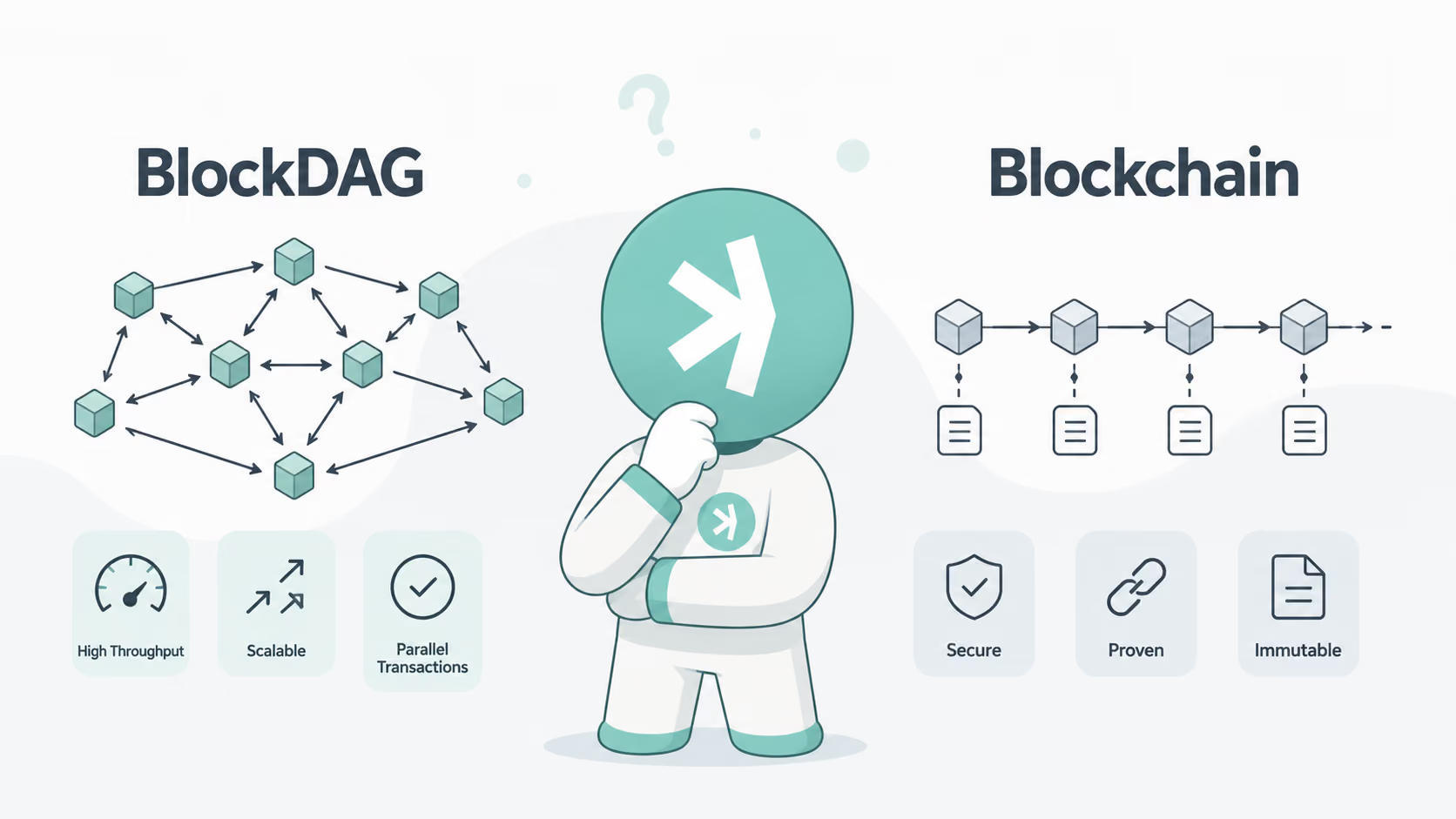
A blockchain links each block to a single parent and discards blocks found at the same time, which forces long block times. A BlockDAG lets a block reference several parents, so parallel blocks are kept and their work counts. Protocols like Kaspa's GHOSTDAG put them in one order, at the cost of more bandwidth and complexity.
The problem with throwing good work away
Every now and then, two Bitcoin miners find a valid block at almost the same moment. For a short while the network has two versions of the latest block, and then one of them wins. The other one, with all the electricity spent to find it, is simply dropped.
On Bitcoin this happens rarely, because blocks come only every ten minutes. But it is the main reason blockchains cannot simply speed up. In this article we will compare the two structures, the classic blockchain and the BlockDAG, look at how a protocol like GHOSTDAG keeps a DAG consistent, and be honest about what the faster design costs.
How a blockchain decides what is true
A blockchain is a list of blocks in which each block contains the fingerprint (hash) of the one before it. Change an old block and every later fingerprint breaks, which is what makes the history tamper-evident.
When two blocks arrive at the same height, nodes temporarily keep both branches and follow the one with the most accumulated proof-of-work. Bitcoin's "heaviest chain" rule settles the race within a block or two. The losing block is called an orphan (Ethereum, back in its proof-of-work days, called them uncles and paid them a partial reward).
The design is simple and battle-tested, but it has a built-in speed limit:
- A block needs time to propagate across the world, typically a few hundred milliseconds or more.
- If new blocks arrive faster than that, collisions become frequent and more mining work is orphaned.
- Large, well-connected pools hear about new blocks first, so frequent orphans quietly favor them over small miners.
- Wasted work also lowers the effective security of the chain, because an attacker's blocks are not wasted in the same way.
That is why Bitcoin keeps a ten-minute interval, and why most fast blockchains moved away from proof-of-work altogether.
What a BlockDAG changes
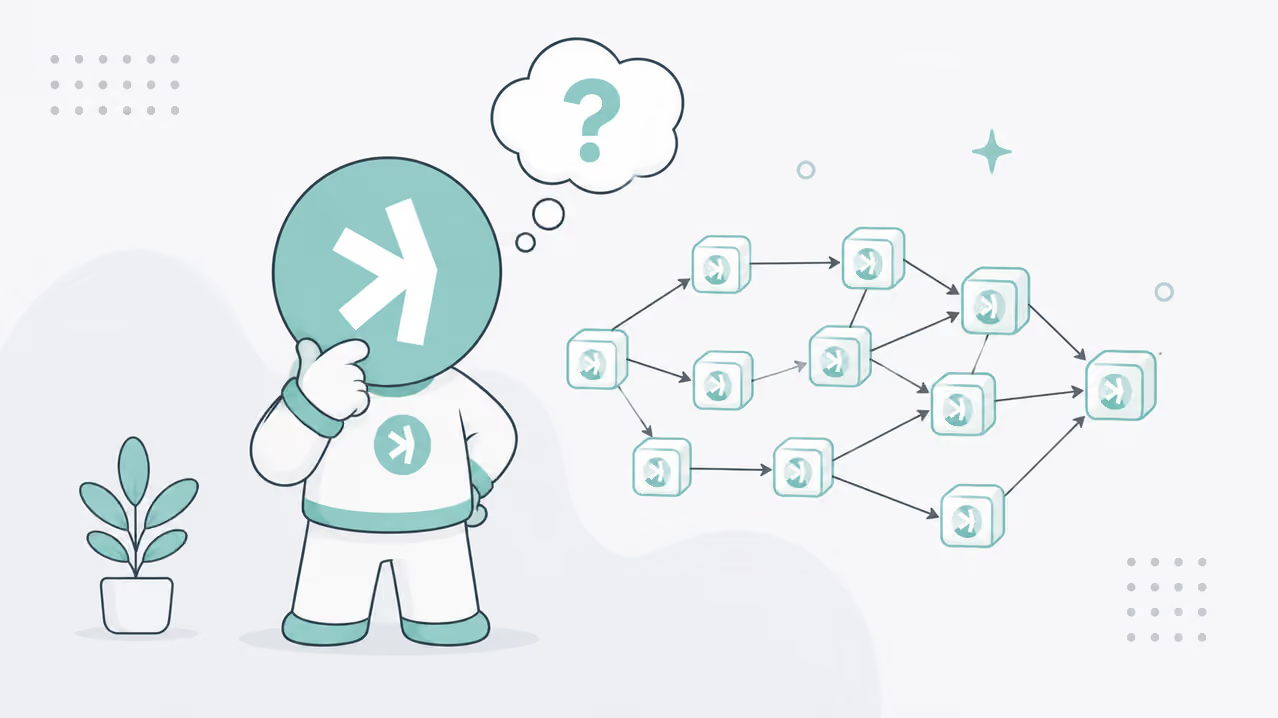
A DAG, or directed acyclic graph, is a set of points connected by one-way arrows that never loop back. In a BlockDAG, the points are blocks and the arrows are references to earlier blocks. The key difference is small to describe: a new block may reference several parents instead of exactly one.
So when two miners find blocks at the same time, nobody has to lose. The next block simply references both. Parallel blocks become part of the record, their proof-of-work counts toward security, and their transactions can be included.
Wait, if two parallel blocks spend the same coins, which spend is valid? A BlockDAG on its own cannot answer that. It needs an ordering rule.
GHOSTDAG: how Kaspa puts parallel blocks in order
Several protocols have been proposed for ordering a BlockDAG. Kaspa uses GHOSTDAG, a practical version of the PHANTOM protocol described by Yonatan Sompolinsky, Shai Wyborski and Aviv Zohar. Its name comes from GHOST, a protocol for chains, but the mechanism is different.
The core idea is to separate honest blocks from suspicious ones. Honest miners publish their blocks immediately and reference everything they know, so their blocks end up tightly connected. A block that was withheld, for example by an attacker mining in secret, stays poorly connected to the rest.
- A parameter k describes how many blocks can honestly be created in parallel, given the block rate and typical network delay.
- Blocks that fit within that limit are marked blue. Blocks that are too poorly connected are marked red.
- Each block chooses as its selected parent the past block with the most blue work. Following selected parents gives a main spine, the selected chain.
- Every chain block orders the other blocks it merges in a deterministic way, and transactions are applied in that order. When two transactions conflict, the earlier one wins.
An interesting detail: with k set to zero, GHOSTDAG behaves like Bitcoin's heaviest-chain rule. A blockchain is, in a sense, a special case of the same idea with no room for parallel blocks.
Chain and DAG in one table
Here is how the two designs compare in practice, using Bitcoin and Kaspa as the reference examples.
| Aspect | Classic blockchain (Bitcoin) | BlockDAG (Kaspa) |
|---|---|---|
| Parents per block | One | Several |
| Blocks found at the same time | One is kept, the others are orphaned | All are kept and ordered |
| Block interval | About 10 minutes | 100 milliseconds (10 blocks per second) |
| Ordering rule | Heaviest chain | GHOSTDAG (blue/red sets, selected chain) |
| Wasted mining work | Low, because blocks are rare | Low, even with very fast blocks |
| Node load | Light | Higher bandwidth and processing |
| Design maturity | Since 2009, very well studied | Kaspa mainnet since 2021 |
What the BlockDAG does not fix
It is tempting to read the table and conclude that DAGs are simply better. They are not free, and a fair comparison has to name the costs.
Every node still does all the work. A BlockDAG does not split the load between nodes. Each node validates every block and every transaction, and at 10 blocks per second that means more data to download and process than on a slow chain. Kaspa keeps disk usage bounded by pruning old block bodies, but the bandwidth requirement is real.
Parallel blocks can repeat transactions. When two miners include the same transaction, the second copy adds nothing. This is why going from one to ten blocks per second did not multiply Kaspa's throughput by exactly ten. The developers expected a gain of roughly eight to nine times.
Security still rests on assumptions. GHOSTDAG's guarantees depend on k being large enough for real network conditions. If latency grows beyond what k allows, honest blocks can be misclassified. This is the problem DAGKnight, Kaspa's planned successor protocol, is designed to address by adapting to latency automatically. And, as in any proof-of-work system, an attacker controlling most of the hashrate can still rewrite recent history.
Fast blocks do not mean instant finality. Confirmation time is limited by how long information takes to cross the network, and that did not change. Kaspa's own developers estimated that going to 10 blocks per second improved confirmation times by around 30%, not tenfold.
More complexity. Ordering a graph is harder to reason about, implement and analyze than following a single chain. Tools like block explorers and wallets have more to handle, too.
Where BlockDAGs are used today
Kaspa is the largest proof-of-work network built on a BlockDAG. Since the Crescendo upgrade of May 2025, it produces 10 blocks per second, and a move toward 100 blocks per second is on its roadmap for 2027. You can read the full overview in our article What is Kaspa?.
Other projects use DAG structures too, but often in a very different way. IOTA, Hedera and Nano, for example, organize transactions or events in graph-like structures without proof-of-work mining, so their trade-offs are not directly comparable. And the BlockDAG Network token (BDAG) is a separate project that only shares the name.
The short version
The classic blockchain is simple, extremely well understood and deliberately slow: it accepts a ten-minute rhythm so that collisions stay rare. A BlockDAG accepts collisions as normal and puts them in order instead, which lets a proof-of-work network run hundreds of times faster without wasting most of its mining work.
What it does not do is make running a node lighter or remove the need for careful protocol design. If you are evaluating a project that calls itself a BlockDAG, the useful questions are: which ordering protocol does it use, what are its latency assumptions, and what does a node need to keep up? Those answers tell you far more than the name.
FAQs
Quick answers to the questions readers ask most about this topic.
In a blockchain each block points to one parent, so blocks found at the same time compete and the losers are discarded. In a BlockDAG a block can point to several parents, so parallel blocks are kept and a consensus protocol puts all of them in one agreed order.
It can produce blocks much more often without wasting mining work. Kaspa, the best-known proof-of-work BlockDAG, makes 10 blocks per second, compared with one block every ten minutes on Bitcoin. Confirmation time still depends on network latency, so it does not shrink in exact proportion.
GHOSTDAG is the protocol Kaspa uses to order the blocks in its DAG. It marks well-connected blocks as blue and isolated ones as red, follows the blocks with the most blue work to build a main chain, and orders every other block relative to that chain.
No. Every node still validates every block and transaction. A BlockDAG with fast blocks actually needs more bandwidth and processing than a slow blockchain. Its gain is that far less mining work is wasted, which lets the network run faster without favoring large miners.
No. BlockDAG is a general data structure used by several projects, including Kaspa. BlockDAG Network (BDAG) is a separate project that happens to use the name. This article is about the data structure.

Author
Bruma- Published
- Last updated