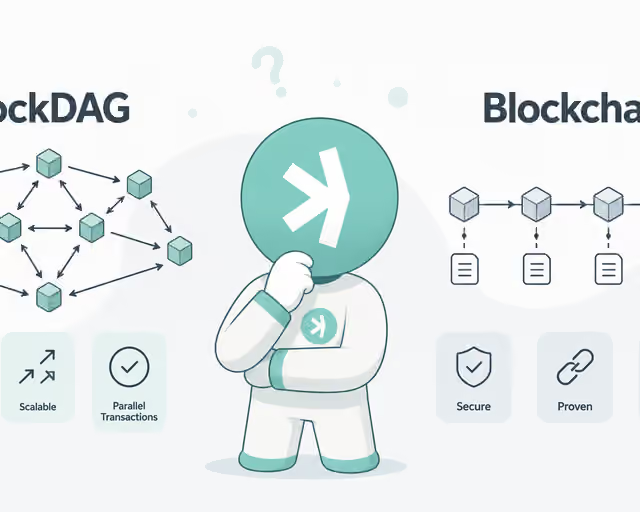
Kaspa vs Ethereum: Two Very Different Approaches
Ethereum scales with proof-of-stake and layer 2s, Kaspa with a fast proof-of-work BlockDAG. Compare speed, finality, supply and smart contracts in 2026.

Bruma
Author

Comparing a city with a highway
Comparing Kaspa and Ethereum is a bit like comparing a busy city with a new highway. The city has everything: shops, banks, offices and millions of residents, but traffic can be slow downtown, so most people use the ring roads around it. The highway is fast and empty, and the towns along it are only starting to be built.
Ethereum is the city. It is the largest platform for smart contracts, and most of its activity has moved to faster "layer 2" networks around it. Kaspa is the highway: a proof-of-work network that is very fast on its own base layer and has only recently gained the tools to host applications. In this article we will look at how differently the two are built, what that means for speed, supply and security, and where each one makes sense.
Different starting points
Ethereum launched in July 2015 with a bold idea: a blockchain that could run any program, not just move coins. Those programs, called smart contracts, became the foundation of decentralized finance, stablecoins, NFTs and much more.

Kaspa launched in November 2021 with a narrower goal: make proof-of-work fast. Its BlockDAG structure keeps blocks created in parallel instead of discarding them, which lets it produce 10 blocks per second. Programmability came later, in 2026. If you are new to it, our article What is Kaspa? is a good starting point.
Stake against work
The biggest technical difference is how each network decides who adds the next block.
Ethereum moved to proof-of-stake with the Merge in September 2022. Validators lock up at least 32 ETH each, take turns proposing blocks every 12 seconds and vote on each other's blocks. If they misbehave, part of their stake can be destroyed ("slashed"). This cut Ethereum's energy use by more than 99% and replaced miners with capital.
Kaspa uses proof-of-work. Miners compete with ASIC machines running the kHeavyHash algorithm, and the BlockDAG lets many of them find blocks at the same time without wasting work.
Each model has a cost. Proof-of-stake is efficient, but it ties influence to how much ETH you hold, and a large share of stake is delegated to a few big staking providers. Proof-of-work spends real energy, and Kaspa's hashrate also flows through a handful of large mining pools. Neither design is free of concentration. The difference is mostly in what you have to own to take part: coins in one case, hardware and electricity in the other.
How each one scales
Ethereum chose to keep its main layer relatively small and push most activity to layer 2 rollups such as Arbitrum, Base and Optimism. These networks bundle thousands of transactions and post compressed data back to Ethereum. Recent upgrades were designed for exactly this: Dencun (2024) added cheap "blob" space for rollup data, and Fusaka (December 2025) expanded that capacity further with a technique called PeerDAS. The next upgrade, Glamsterdam, reached the Sepolia test network in October 2026 and has no mainnet date yet.
The result is a layered system. Ethereum's main layer handles a few dozen transactions per second, while its layer 2s together handle far more. Fees on both have been low for most of the time since 2024, although they can rise when demand spikes.
Kaspa scales its base layer directly. Since the Crescendo upgrade of May 2025 it produces 10 blocks per second, with reported capacity in the low thousands of transactions per second, and a step toward 100 blocks per second is targeted for 2027. There is no need to bridge funds to another network to get speed, but Kaspa also does not yet have a rollup ecosystem of Ethereum's size.

Speed and finality
Speed is two separate things: how quickly a transaction is included, and how quickly it becomes practically irreversible.
On Ethereum's main layer, a transaction is usually included within one 12-second block. Full economic finality, the point where reversing it would require destroying a large amount of staked ETH, comes after two epochs, about 13 minutes. Layer 2s confirm transactions within seconds, but their final settlement depends on Ethereum underneath.
On Kaspa, a transaction usually appears in a block within a second and is described by the project as fully confirmed in about ten seconds on average. As on Bitcoin, finality on Kaspa is probabilistic: each additional second of blocks on top makes a reversal more expensive, rather than reaching a single "final" checkpoint.
Supply and monetary policy
Ethereum has no maximum supply, with about 120 million ETH in existence. New ETH is paid to validators, and since 2021 a part of every transaction fee is burned. When the network is busy, burning can outweigh issuance and the supply shrinks; when it is quiet, the supply grows slowly.
Kaspa has a fixed cap of about 28.7 billion KAS, issued only through mining. The block reward drops about 5.6% every month, halving every year, and around 96.7% of the supply had been mined by October 2026. Its supply is predictable, but miners will depend more and more on transaction fees as the reward shrinks. Our tokenomics page shows how that curve looks.
Smart contracts and ecosystem
Here Ethereum is far ahead, and it would be misleading to pretend otherwise. It has the largest smart contract ecosystem in crypto, years of battle-tested applications, the most developers and the deepest liquidity in decentralized finance. Its programming model, the EVM, has become a standard copied by many other chains.

Kaspa's programmable side is new. The Toccata hard fork of June 2026 added covenants, which are rules attached to coins about how they can be spent, and native verification of zero-knowledge proofs. These are intentionally more limited than general-purpose contracts, which keeps the base layer simpler to secure. For full smart contracts, the Igra network has run EVM-compatible contracts on top of Kaspa since March 2026, so Solidity developers can reuse Ethereum tools. KRC-20 tokens also exist. It is a promising start, but it is a start.
The key differences at a glance
| Feature | Ethereum | Kaspa |
|---|---|---|
| Launch | July 2015 | November 2021 |
| Consensus | Proof-of-stake (since September 2022) | Proof-of-work, GHOSTDAG BlockDAG |
| Block time | 12 seconds | 100 milliseconds (10 blocks per second) |
| Finality | About 13 minutes (2 epochs) | Probabilistic, about 10 seconds in practice |
| Scaling approach | Layer 2 rollups, blob data | Faster base layer |
| Supply | About 120 million ETH, no cap | About 28.7 billion KAS, capped |
| Smart contracts | General-purpose EVM | Covenants and ZK on L1, EVM via Igra |
| Ecosystem size | Largest in crypto | Early stage |
The trade-offs in plain words
Ethereum's strengths are its ecosystem, its developer base and the fact that almost every new idea in crypto is built there first. Its weaknesses are a more complex system, where users must understand which layer and which bridge they are using, and a monetary policy without a fixed cap.
Kaspa's strengths are a fast, simple base layer secured by proof-of-work and a supply that is almost fully issued. Its weaknesses are a small ecosystem, a much smaller market (around $1.2 billion in October 2026, compared with Ethereum's hundreds of billions) and programmability features that are only months old.
So, which one should you look at?
They are not really competing for the same job yet. If you want to use or build decentralized applications today, Ethereum and its layer 2s are where the users, liquidity and tools are. If you care about proof-of-work security with fast confirmations on the base layer, Kaspa is the most advanced design of that kind, and its new EVM layer gives Ethereum developers an easy way to experiment with it.
The interesting question for the next few years is whether Kaspa's highway attracts enough builders to become a city of its own. You can follow Kaspa's network and market data live on the KaspHub dashboard.
FAQs
Quick answers to the questions readers ask most about this topic.
No. Ethereum switched from proof-of-work to proof-of-stake with the Merge in September 2022. Its blocks are now proposed by validators who lock up ETH, while Kaspa is still secured by miners using proof-of-work.
Kaspa's base layer is faster: it makes 10 blocks per second and confirms transactions in about ten seconds. Ethereum produces a block every 12 seconds and reaches full finality after about 13 minutes, but most Ethereum activity now happens on layer 2 networks that confirm transactions within seconds.
Yes, through the Igra network, an EVM-compatible layer that launched on top of Kaspa in March 2026. Kaspa's own base layer gained covenants and zero-knowledge proof verification with the Toccata upgrade in June 2026, which are more limited than Ethereum's general-purpose contracts.
No. Ethereum has no hard cap. New ETH is issued to validators, and part of every transaction fee is burned, so the supply can grow or shrink slightly depending on network activity. Kaspa is capped at about 28.7 billion KAS.
Ethereum's, by a wide margin. It has the largest smart contract ecosystem in crypto, with years of DeFi, stablecoin and developer activity across its main network and its layer 2s. Kaspa's smart contract ecosystem only started to form in 2026, although KRC-20 tokens have existed since 2024.

Author
Bruma- Published
- Last updated